
RESOURCES
BLOG
Join in the community forum! The thINK blog is a place for community members to share their opinions, best practices, successes, and challenges. Add your comments to the blogs published here or write a blog and we’ll post it for you.

What the USPS is Doing About Declining Mail Volumes
Every November, the United States Postal Service (USPS) releases its fiscal year financial results. This
annual announcement always provides important insight into the state of the USPS. This has been a year
of significant change at the top, with the arrival of a new Postmaster General, David Steiner. Steiner,
who started in July, replaced Louis DeJoy, who retired after serving from 2020 to 2025. In reviewing the
USPS’s fiscal results, what is most interesting to me is how the USPS is adjusting to declining mail
volumes.
Declining U.S. Mail Volumes
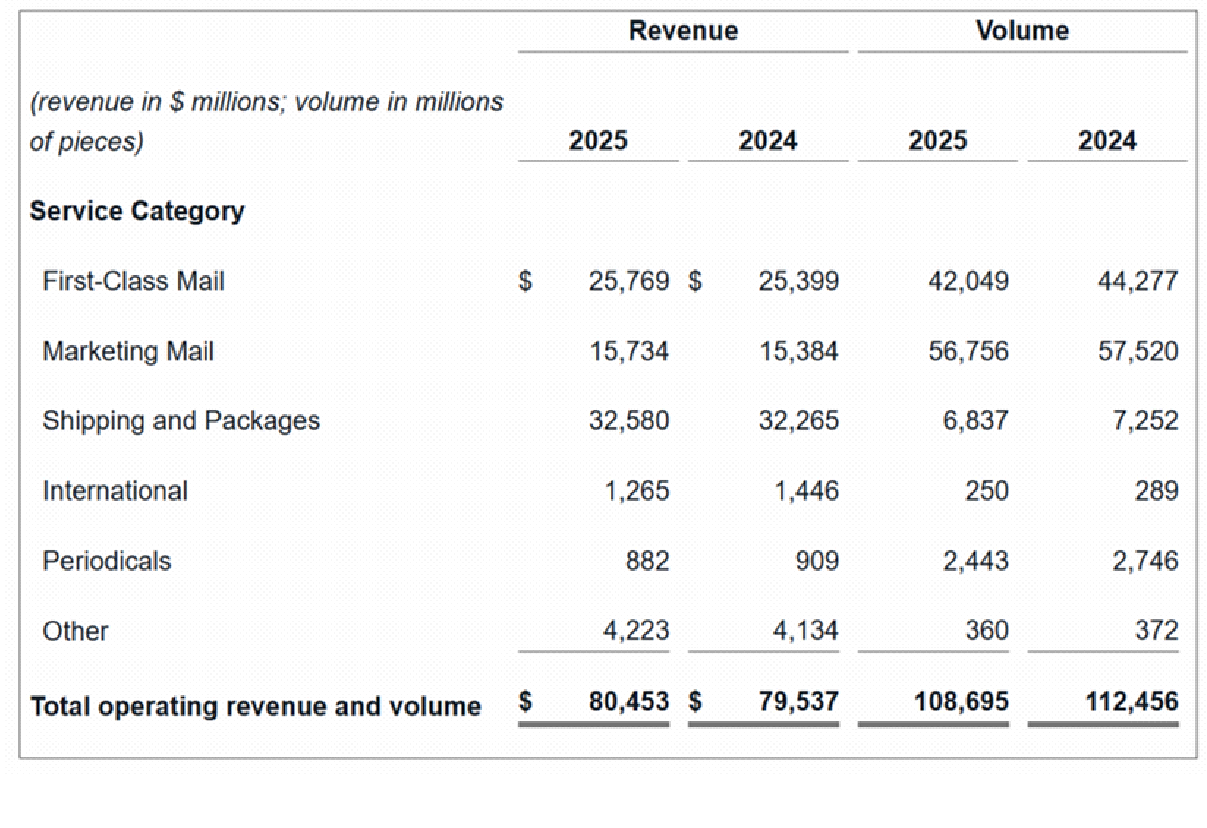
Despite ongoing losses that amount to nearly $9 billion annually, the somewhat good news is that fiscal
year revenues for the USPS increased by about 1.2% between 2024 and 2025. This growth was driven by
programs like USPS Ground Advantage as well as postal price increases. On the downside, mail volumes
are decreasing across all categories.
Figure 1: Fiscal Year 2025 Operating Revenue and Volume by Service Category
Source: United States Postal Service, November 2025
Pricing Increases
Postal pricing increases are part of the USPS’s plan for 2026. On the same day that it announced its 2025
fiscal year results, the USPS recommended new postal rates for 2026. These changes have been
approved by the Postal Regulatory Commission and will take effect on January 18, 2026. The increases
are as follows:
- Priority Mail: 6.6%
- Priority Mail Express: 5.1%
- USPS Ground Advantage: 7.8%
- Parcel Select: 6.0%
The price of a first-class stamp will not increase at this time. The most recent increase occurred in July of 2024.

Between a Rock and a Hard Place
When reporting its results, the USPS breaks its losses into two categories: Controllable and Not
Controllable. Its “controllable” losses are those that USPS management can impact through its actions.
The USPS uses these categories to make the point that for a significant portion of losses, its hands are
tied by Congressional and other inaction. Of the nearly $9 billion in 2025 fiscal year losses, the USPS
stresses that it can only control about 30%. It has been begging for years for greater ability to control its
retirement assets and its workers compensation program. The USPS also complains about unfunded
mandates and missteps by the Postal Regulatory Commission.
Providing Value in an Era of Volume Decline
In explaining the USPS’s 2025 results, Steiner said, “Our value resides in going to every address, six and
often seven days a week, while offering a remarkable retail and processing footprint, as part of our
universal service offering.” He continued, “…our last mile has been historically undervalued and
underused. Simply put, we have the capacity to meet a much larger percentage of America’s shipping
needs—we just need to use our assets efficiently and effectively.”
He noted the astounding decline in volume by stating, “compared to 18 years ago, customers now send
about 110 billion fewer pieces through our system every year.” Any institution would struggle to
reinvent itself in the face of headwinds like these volume declines. He urged the government to allow
the USPS to borrow like its competitors, rather than being limited by statute as it currently is. He
encouraged all USPS stakeholders, including Congress, the Administration, the Postal Regulatory
Commission, the Inspector General, mailers, postal unions, and customers, to “reengage with fresh
ideas.”
In closing, Steiner noted, “We offer unparalleled value for the universal work we do. In return, we ask
only for common sense business rules in the way we manage pricing, logistics, and our short-term and
long-term obligations.”
Conclusion
So, what is the USPS doing about declining mail volumes? In short, it is automating, increasing rates for
some types of mail, and focusing on increasing its share of the package shipping market. Postmaster
Steiner seems satisfied to continue Louis DeJoy’s initiatives, at least while he grounds himself in the
ongoing operation of the USPS. Steiner and DeJoy are aligned in their frustration with Congress and
other groups that limit the USPS’s ability to decrease its losses. Whether any of their concerns can be
addressed remains to be seen, but it unfortunately does not seem very likely given the current political
climate.
Author bio: Jim Hamilton of Green Harbor Publications (www.greenharbor.com) is an industry
analyst, market researcher, writer, and public speaker. For many years he was Group Director
in charge of Keypoint Intelligence’s (formerly InfoTrends’) Production Digital Printing &
Publishing consulting services. He has a BA in German from Amherst College and a Master’s in
Printing Technology from the Rochester Institute of Technology.